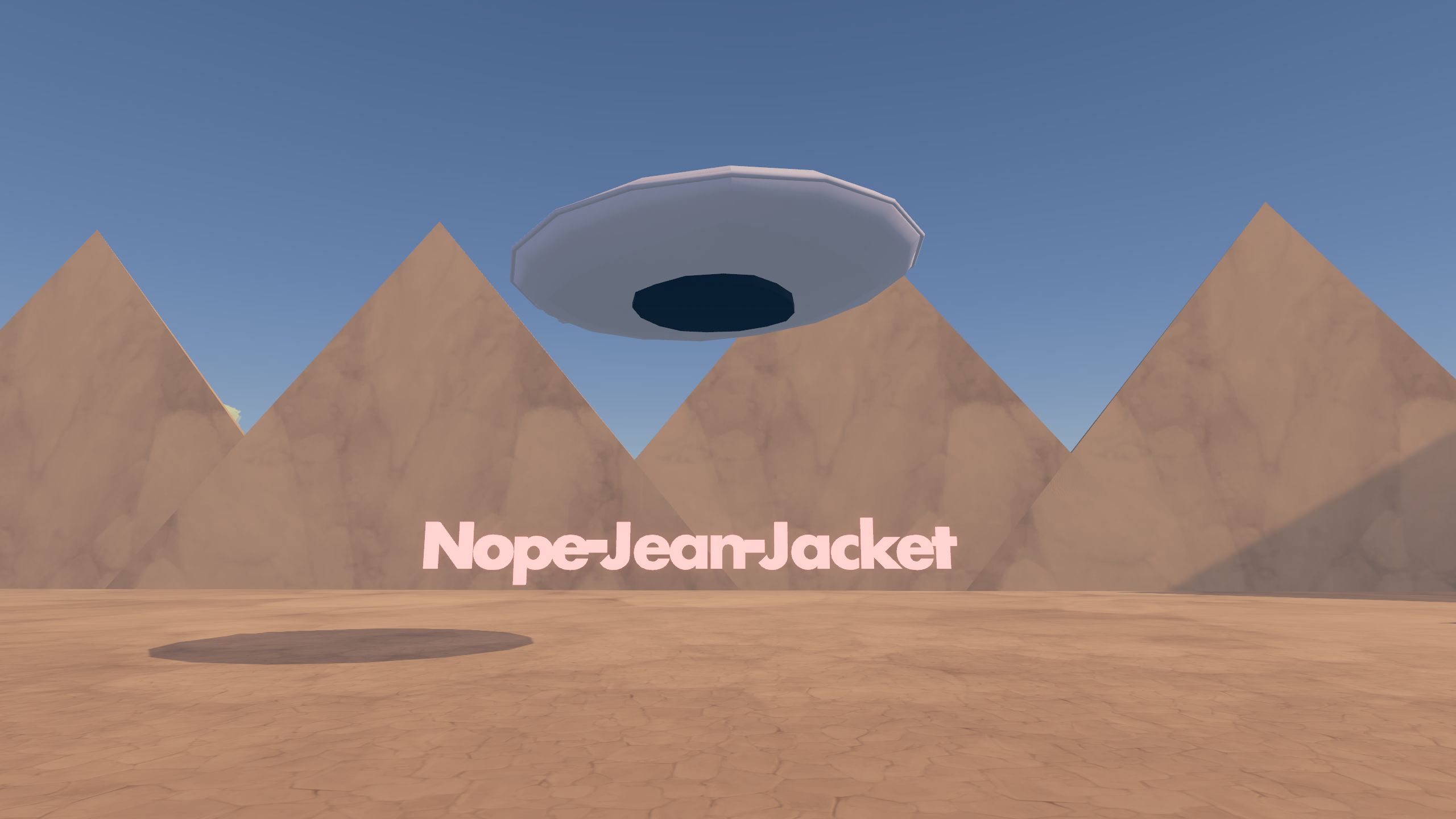
It looks like a hat. Maybe a frisbee. Honestly, when we first see the "UFO" in Jordan Peele’s 2022 film Nope, it feels almost too traditional. We’ve seen the silver saucer a thousand times in 1950s B-movies and The X-Files. But then things get weird. The movements aren't mechanical. They’re predatory. By the time the third act rolls around, we realize we aren't looking at a ship at all. We are looking at an animal.
The jean jacket nope anatomy is a masterclass in biological horror. It’s not just a cool visual effect; it is a fully realized, speculative organism designed by a team of scientists and concept artists to feel like something that could actually exist in our atmosphere. Peele didn't just want a monster. He wanted a predator that felt like it belonged to the same evolutionary tree as a jellyfish or a giant squid, just... in the sky.
The Biology of a Cloud-Dweller
The creature, nicknamed "Jean Jacket" by the protagonist OJ Haywood, is a facultative aero-zoan. That’s a fancy way of saying it’s an animal that lives its entire life in the air. To make the jean jacket nope anatomy feel real, Peele brought on John Dabiri, a professor of aeronautics and mechanical engineering at Caltech. They didn't want anti-gravity engines. They wanted biology.
The creature’s primary form is a disc. It’s roughly 250 feet across. Most of that mass is a highly specialized mantle, similar to what you’d find on a cephalopod. It uses a combination of magnetic field manipulation and a biological version of "ionic wind" to stay aloft. It doesn't fly like a bird. It floats like a jellyfish in a current. This explains why it stays so still inside the clouds. It isn't "parked." It’s waiting.
Think about the texture. It isn't metallic. It’s skin. A tough, leathery hide that can change color and texture to mimic the vapor of a cumulus cloud. This is active camouflage at its most terrifying. When Jean Jacket sits in the "home" cloud, it isn't just hiding; it is integrating its body into the environment.
The Internal Digestion System
The most disturbing part of the jean jacket nope anatomy is the "interior." We see this during the infamous "Star Lasso Experience" scene. It’s a claustrophobic, wet, screaming nightmare.
The mouth isn't a set of jaws. It’s a specialized suction pore on the underside. Once the creature creates a vacuum—a literal localized low-pressure zone—it pulls everything upward. This is where the anatomy gets weirdly efficient. The throat is a series of rhythmic, muscular folds. If you’ve ever seen a snake swallow a rat, imagine that, but square and lined with vibrating green fabric-like membranes.
It doesn't have teeth. It has pressure.
The screams we hear from inside the creature aren't just for dramatic effect. The people are being crushed and suffocated by the internal walls of the esophagus. Jean Jacket is a highly efficient calorie-burner. It digests organic matter—horses, people, dogs—and spits out the rest. The "blood rain" scene at the Haywood ranch happens because the creature has a biological limit. It’s essentially "purging" the indigestible bits: keys, coins, blood, and a nickel that ends up killing a man.
The Unfurled Form: Biblical Angels and Origami
When Jean Jacket feels threatened by the giant inflatable "Wacky Waving Inflatable Arm Flailing Tube Man," it undergoes a metamorphosis. This is the "True Form" or the "Unfurled Form."
This is where the jean jacket nope anatomy shifts from sci-fi to something more spiritual—or Lovecraftian. The disc unfolds into a massive, billowing structure that looks like a cross between a square sail and a tropical flower.
- The central "eye" is a square, green aperture.
- The rhythmic pulsing of the sails creates a mesmerizing effect.
- The movement becomes more erratic and aggressive.
The design was heavily influenced by "biblically accurate angels." If you look at descriptions in the Book of Ezekiel, you see talk of wheels within wheels and eyes everywhere. Peele and his VFX team at MPC (Moving Picture Company) wanted that same sense of "I should not be looking at this."
It’s a display of dominance. In nature, animals puff themselves up to look bigger. Jean Jacket isn't just trying to eat at this point; it’s trying to intimidate. The square eye is particularly fascinating. Most predators have slit or round pupils. The square shape suggests a different way of processing light and depth, potentially allowing the creature to track multiple targets across a wide-angle horizon without moving its "head."
Why the Anatomy Matters for the Story
Everything about how this thing is built reinforces the movie's theme: the "bad miracle."
The creature reacts to eye contact. In the animal kingdom, staring is a challenge. Because Jean Jacket’s anatomy is built around a singular, massive ocular-intake system, looking at it is like pointing a weapon at it. OJ realizes this because he works with horses. He understands that you don't look a predator in the eye unless you want a fight.
The "Nope" in the title comes from that realization. When you see something that breaks the laws of what you thought was possible, your first instinct is to look. But the jean jacket nope anatomy is designed specifically to punish the viewer. It is a biological machine built to consume those who can’t look away.
The Sound of the Beast
We can't talk about anatomy without talking about the vocalizations. Sound designer Johnny Burn didn't use electronic synths. He used organic sounds. He used recordings of wind whistling through canyons and the sound of skin stretching.
When Jean Jacket "screeches," it’s the sound of air being forced through those internal muscular folds. It’s a literal wind instrument. This makes the creature feel grounded. It has a respiratory system. It has a pulse. It has a voice that sounds like the very atmosphere it inhabits.
Actionable Insights for Horror Fans and Creators
Understanding the jean jacket nope anatomy changes how you watch the film and how you think about monster design in general. If you're a writer, artist, or just a nerd for creature features, there are a few "rules" we can take away from Jordan Peele’s design process:
- Ground the fantastical in the familiar. Jean Jacket works because it shares traits with jellyfish and octopi. We recognize the movement, which makes it scarier because we know how those animals hunt.
- Form must follow function. The creature isn't a disc because it looks cool; it's a disc because it needs to create lift and hide in clouds.
- The "Unseen" is a part of anatomy. The most terrifying part of the creature's biology is what happens inside. By showing us the "throat" from the perspective of the victims, the movie makes the anatomy personal.
- Respect the animal. Treat the monster like a predator with needs (hunger, territory, fear) rather than a villain with a "plan."
The genius of Jean Jacket is that it feels like a discovery, not an invention. It feels like something that has been up there for centuries, hiding in plain sight, just waiting for someone to look up.
If you're looking to dive deeper into the world of speculative biology, check out the work of Terryl Whitlatch, the creature designer for Star Wars, or look into the "Sky Whale" theories of 20th-century cryptozoology. The idea of atmospheric beasts isn't new, but Nope gave us the most scientifically rigorous version of it we’ve ever seen.
Next time you see a cloud that doesn't move, remember the anatomy. Remember the square eye. And for God's sake, don't look at it.