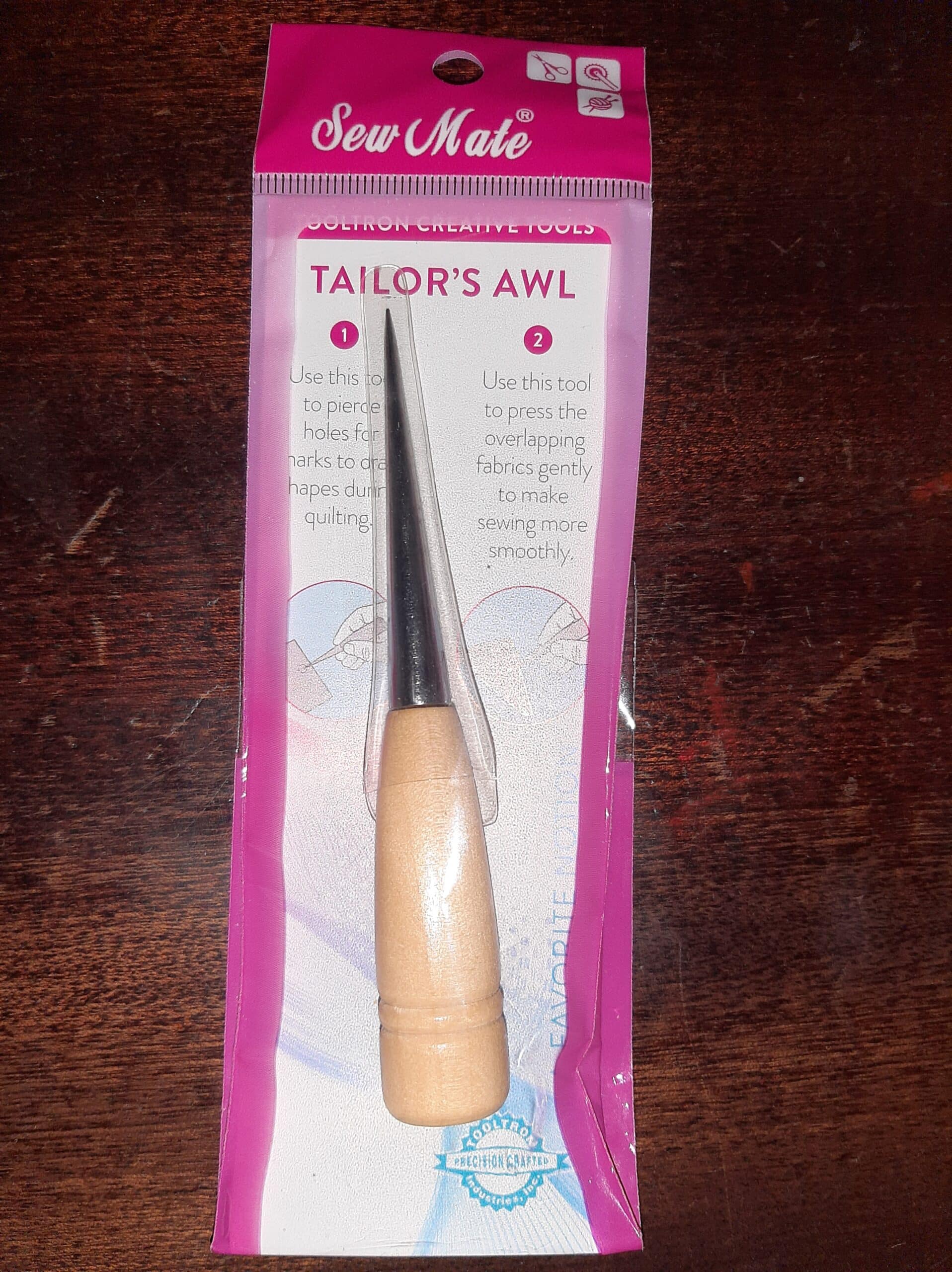
If you’ve ever tried to force a standard sewing needle through a piece of 8oz veg-tan leather or a thick slab of heavy-duty canvas, you know the exact moment your spirit breaks. It usually happens right when the needle snaps or your thumb turns purple from pushing. Honestly, it’s a mess. Most people think they need a $3,000 industrial Juki machine to handle the heavy stuff, but they’re wrong. You just need a stick with a hole in it. Well, a very specific kind of stick. Sewing with an awl is one of those "lost arts" that isn't actually lost—it’s just been buried under a mountain of plastic consumer goods.
People get intimidated. They see the sharp metal point and the weird wooden handle and assume it’s too technical. It isn't. It’s basically just manual labor disguised as a craft. Whether you're fixing a ripped Jeep soft-top, repairing a horse saddle, or making a custom sheath for a bushcraft knife, the stitching awl (often called a "speedy stitcher") is your best friend. But if you use it wrong, you’ll end up with a tangled nest of waxed thread and a very sore palm.
Let’s get into the weeds of how this actually works without the fluff.
Why Your First Attempt Probably Failed
Most beginners pick up a stitching awl, shove it through the material, and then realize they have no idea where the second thread goes. They treat it like a regular needle. Big mistake. A sewing awl isn't a needle; it's a portable lockstitch machine. When you're sewing with an awl, you are essentially mimicking what a sewing machine does with a bobbin, but you're doing it by hand.
The most common error? Tension. If you pull too hard on one side, your seam puckers. If you don’t pull hard enough, the stitches look like loose spaghetti. I’ve seen guys try to repair boat sails with an awl and end up with a seam that unrolls the second it hits a gust of wind. It’s all about the "loop." You push the needle through, pull a bit of thread back to create a loop, and then manually pass the "bobbin" thread through that loop. It sounds tedious. It kind of is. But once you find the rhythm, it's faster than any other hand-stitching method for heavy materials.
The Gear: Not All Awls are Equal
You can buy a cheap awl for five bucks at a hardware store, but you'll regret it. The needles are brittle. The wood handles splinter. If you're serious, you look for brands like C.A. Myers (the original Speedy Stitcher) or Osborne. These have been the gold standard since the early 1900s.
A real kit should include:
- A hollow wooden handle (this holds your thread spool).
- A tension post or nut (this is crucial for keeping your stitches even).
- At least two needles: a straight one and a curved one for tight corners.
- Waxed polyester or nylon thread. Do not use cotton. Cotton rots.
I remember talking to a master saddlemaker in Wyoming who told me he’d used the same Osborne awl for thirty years. He’d replaced the needles a hundred times, but the tool itself was part of his hand. That's the level of reliability we're talking about.
The Step-by-Step Rhythm of the Lockstitch
First, you’ve got to prep the thread. Pull out a length of thread that is roughly three times the length of the seam you're sewing. This is a rough estimate—some people prefer four times the length just to be safe. Nothing sucks more than running out of thread two inches from the finish line.
Thread the needle through the eye. Now, push that needle through your starting hole. Pull the entire length of the "free" thread through to the back side of the material. Now, pull the needle back out. You should have the awl on one side and the long tail of thread on the other.
Move forward about 1/4 inch and push the needle through again. This is where the magic happens.
Pull the needle back just a tiny bit—maybe half an inch. This creates a small loop of thread inside the hole. Now, take that long tail of thread you have on the back side and pass it through that loop. Pull the needle back out completely. Pull both threads tight. Boom. You just made a lockstitch.
Repeat this until your fingers go numb or the project is done.
Dealing With the Friction
Leather is stubborn. Sometimes the needle gets stuck. If you're struggling to pull the awl back out, don't wiggle it side-to-side. You'll snap the tip. Instead, use a bit of beeswax on the needle. It sounds like an old wives' tale, but it works. The wax lubricates the metal and allows it to slide through the fibers of the leather or canvas without grabbing.
If you're working with exceptionally thick material, like two layers of 10oz leather, you might need to pre-punch your holes. Use a diamond chisel or a rotary punch. Trying to force a stitching awl through 20oz of leather is a great way to end up in the emergency room with a puncture wound in your palm. Trust me on that one.
Misconceptions About the "Speedy" Part
The name "Speedy Stitcher" is a bit of a marketing lie. It's not fast compared to a machine. It's fast compared to using two needles and a stitching pony for a traditional saddle stitch.
The saddle stitch is technically superior because if one thread breaks, the whole thing doesn't unravel. With a lockstitch (which the awl creates), if the thread breaks and you pull on it, the whole seam can potentially "zip" open. However, if you're using heavy-duty waxed thread and your tension is dialed in, this almost never happens in real-world use.
I’ve seen bushcraft bags held together with awl stitches that have survived ten years of being dragged through briars and mud. The "inferiority" of the lockstitch is mostly theoretical for 99% of hobbyists.
Real-World Application: The Jeep Soft Top Fix
A few years back, a friend of mine had the rear zipper on his Wrangler rip away from the fabric. A shop quoted him $400 for a replacement. We sat in the driveway with a $15 stitching awl and some black #277 bonded nylon thread. It took two hours and three beers.
The trick was using the curved needle. Because we couldn't get behind the fabric easily, the curve allowed us to "scoop" the stitch. It wasn't the prettiest seam in the world, but it held up through three winters and a cross-country trip. That’s the utility of sewing with an awl. It’s the ultimate "fix-it" tool for stuff that’s too big for a kitchen table.
Troubleshooting Your Tension
If your stitches look like little loops sitting on top of the leather, your tension is too loose. If the leather is folding over itself like an accordion, it's too tight.
You want the "knot" of the lockstitch to live right in the middle of the material. You shouldn't be able to see the crossover from either side.
- Top-side loops: Tighten the thread coming from the awl handle.
- Bottom-side loops: Pull the tail thread tighter before completing the next stitch.
- Uneven spacing: Use a marking wheel (overstitch wheel) before you start. It leaves tiny dots so you know exactly where to poke the needle.
It takes about twenty or thirty stitches to find the "zone." Don't start on your final project. Take a scrap piece of denim or leather and just practice. It's a tactile skill. Your hands need to learn the feeling of the thread "seating" into the hole.
Advanced Tips for Longevity
When you get to the end of your seam, don't just tie a knot and snip it. That’s amateur hour.
Backstitch at least two or three holes. This means you turn around and go back over the stitches you just made. After backstitching, pull both threads to the "ugly" side of the project. Tie a square knot. Then—and this is the secret—use a lighter to slightly melt the ends of the nylon thread. Press the molten glob down with your thumb (carefully!). This fuses the thread together and ensures it will never, ever pull back through.
If you're using natural fiber thread (like linen), you can't melt it. You'll need a drop of super glue or specialized "Fray Check" to secure the ends.
Limitations to Keep in Mind
You shouldn't use a sewing awl on delicate fabrics. Don't try to fix a silk shirt or a pair of thin dress slacks with this. You will ruin them. The needles are thick—usually around a size #8 or #4. They leave big holes. This tool is a hammer, not a scalpel.
Also, watch your thread weight. If the thread is too thin for the needle, the hole won't close up around it, and your project will leak water. If the thread is too thick, it won't fit through the needle eye. Match your components. Most awls come with "medium" thread, which is fine for general repairs, but keep some "heavy" on hand for boot soles or heavy canvas.
Your Next Steps for Success
To get started, don't just buy the tool and stare at it. Go to a local craft store or an online leather supplier like Tandy Leather and grab a bag of "remnant" scraps.
- Practice on different thicknesses. Try sewing two pieces of thin leather, then move up to four layers of canvas.
- Maintain your tool. Use a bit of fine-grit sandpaper (1000+) to polish your needles if they start to feel "grabby." A polished needle is a happy needle.
- Get a thimble. Even with a handle, you'll be doing a lot of pushing. A leather sailmaker's palm is even better if you're planning a massive project like a boat cover.
Once you master the rhythm, you'll find yourself looking for things to fix. That old leather belt that’s falling apart? Fixed. The strap on your favorite backpack? Stronger than it was when it left the factory. It's a superpower in a wooden handle. Just watch your fingers—that needle doesn't care if it's piercing leather or your left index finger.